
Reviewed by Arisa Tanaphon, Certified Tai Chi Instructor, Mindful Movement Specialist
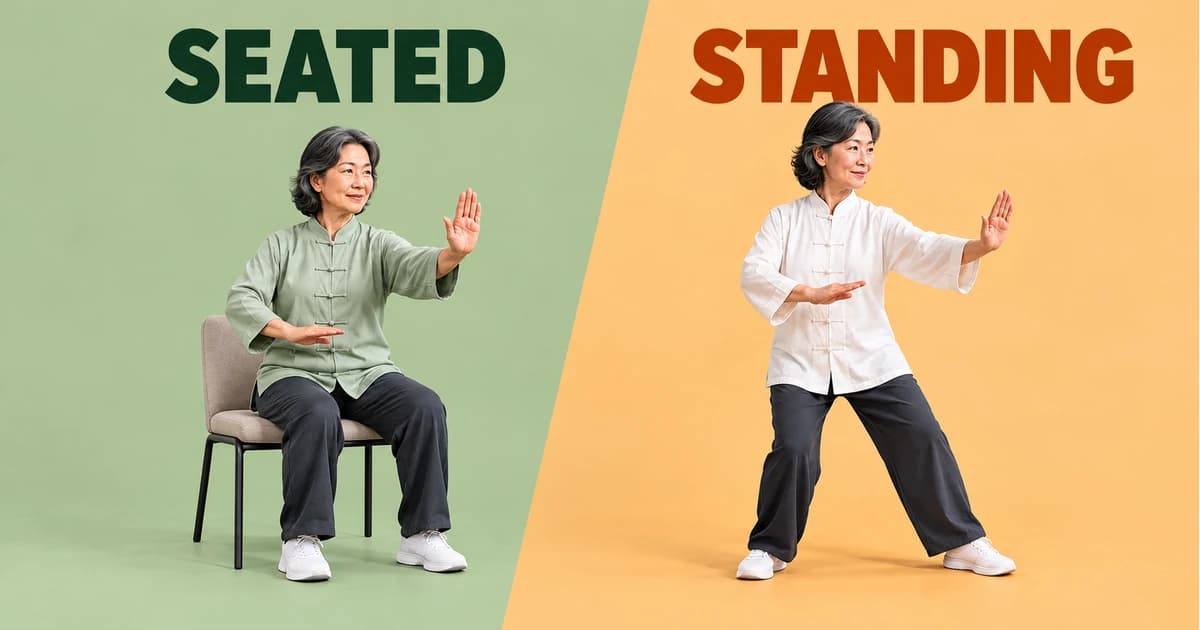
Choose Chair Tai Chi when a stable seat makes practice more manageable or when you want a seated sequence of arm, torso, and leg movements. Choose standing practice when you can comfortably stand and want to rehearse weight transfer between your feet. Neither choice is automatically easier in every movement.
Tai Chi for Seniors & Beginners has separate standing and chair tracks. The chair track has its own videos, movements, and plans, so switching tracks gives you a different sequence. This guide explains what to check before choosing.
Key takeaways
- Chair Tai Chi emphasizes seated posture and coordinated movement. Standing Tai Chi adds weight-bearing balance, weight shifts, and footwork; choose by your current comfort and support needs.
- Tai Chi for Seniors & Beginners keeps the 2 tracks separate, with different sequences, videos, and saved progress. Switching tracks does not turn a standing movement into its chair equivalent.
- Beginner day 1 has 10 short-version movements in either track; the extended standing version has 21, while the extended chair version has 14.
- Compare Sunrise Flow’s planted standing arm lift with Upward And Forward Press’s seated forward-and-upward path. Preview the actual movements instead of choosing from the session title alone.
What changes when you sit down?
| Practice question | What to compare |
|---|---|
| Where is the body supported? | Chair: the seat supports your body. Standing: your feet carry your weight throughout the movement. |
| What happens to the legs? | Chair sequences can include marches, knee lifts, foot taps, and extensions. Standing sequences also include shifts, steps, squats, and balance holds. |
| Do the arms still work? | Both tracks include arm circles, reaches, and opening patterns. Seated practice can still feel demanding in the shoulders. |
| Which trains standing balance? | Standing practice directly involves weight transfer over the feet. A seated pattern is a different task. |
Check the chair and the complete sequence
Use a firm, stable chair without wheels, on a surface where it will not slide. Keep space around the arms and feet. NHS guidance on sitting exercises recommends a solid chair, feet flat, and gradual progression.
A seated label does not mean every movement is suitable for every mobility limitation. For example, the library contains Sit To Stand, which starts in a chair but includes rising. Other chair movements lift both the arms and a leg. Read the actual sequence rather than choosing only by its category.
See two seated movement patterns
Seated Arm Circles
- Extend both arms out to the sides and make slow, controlled circles.
- Notice how a slower speed requires more strength and control.
- Find a pace that works for you.
Foot Taps In And Out
- Place your palms on your lap and tap your feet out wide, then bring them back together in a comfortable rhythm.
- Keep the movement light and relaxed to wake up the legs and improve coordination.
What to preview in a standing workout
Watch for steps across the body, one-leg holds, and deeper knee bends. The Gentle Morning Warm-Up is labeled beginner, but includes Side Flow Step, which crosses one foot behind the other. Your readiness for that movement matters more than the label.
If you are learning to transfer weight, start with Side to Side Sway, keeping the movement small and support nearby. See the balance exercise guide for the difference between two-feet-planted drills and knee lifts.
How the two tracks work in our app
Choose standing Tai Chi or Chair Tai Chi during setup. You can change the workout type later in plan settings. Each track keeps its own plan progress, so completed days from one track do not mark the other track as completed.
Both tracks offer five levels and short or extended day sequences. The longer option adds movements within a day. Preview the standing beginner plan and seated beginner plan to compare the first week instead of assuming that the day numbers mean identical exercises.
Make the choice for today’s practice
- If you need a seated option, open Seated Sunrise Flow and inspect its arm and leg movements.
- If you are comfortable standing, choose a standing sequence whose steps and knee bends you can control.
- If shoulder movement is the limiting factor, check arm height in either track and use a smaller range.
- If you have recent falls, new symptoms, or activity restrictions, ask for individual guidance before selecting balance or transition exercises.
For a step-by-step seated introduction, continue with Seated Tai Chi for Beginners. You can read the instructions and watch the demonstrations on the website before deciding to use the app.
Match the format to your situation
For help deciding how much standing support to use, start with Tai Chi for seniors. If joint pain is your main concern, read Tai Chi for arthritis before assuming that sitting makes every movement suitable. These two formats also differ from the distinction between Tai Chi and Qigong.
Updated: October 16, 2026