
Reviewed by Arisa Tanaphon, Certified Tai Chi Instructor, Mindful Movement Specialist
Tai chi comes up again and again in arthritis discussions because it solves a real problem: many people with joint pain need movement, but the wrong movement can feel discouraging fast. Tai chi is often described as joint-friendly because it is slow, adaptable, and low impact. NCCIH summarizes evidence suggesting tai chi may help with pain and function in osteoarthritis, while CDC’s arthritis program page highlights arthritis-appropriate, evidence-based interventions that can help people move more and function better.
That does not mean tai chi is a cure. It means it deserves a serious look.
Key takeaways
- The strongest evidence for tai chi and arthritis is in osteoarthritis, especially knee osteoarthritis.
- Tai chi is often used because it is low impact, adaptable, and balance-focused.
- Major reviews and guidelines support tai chi as a reasonable option for osteoarthritis management.
- People with rheumatoid arthritis may still benefit from movement, but the tai chi-specific evidence is less certain.
- Seated or modified tai chi can be a smart entry point when standing practice feels too demanding.
Why tai chi is often recommended for arthritis
Arthritis is not just about pain. It is also about stiffness, confidence, fatigue, balance, and the feeling that movement might make things worse. Tai chi is useful here because it reduces the pressure to “push through” discomfort. The pace is slower, the stance can be higher, and the range of motion can be scaled.
That fits with CDC’s page on physical activity and arthritis, which lists tai chi among joint-friendly physical activities that put little or no stress on the joints.
BMI Calculator (Adults 18+)
Calculate your body mass index and check your weight category.
Formula: BMI = weight(kg) / height(m)²
This calculator is for adults aged 18+ and is for guidance only.
For adults, BMI uses the same formula for female and male users.
Do not use this tool if you are pregnant, under 18, have (or may have) an eating disorder, or have a condition that affects height.
What the research says for osteoarthritis
The most reliable tai chi evidence in arthritis is in osteoarthritis. The 2019 American College of Rheumatology / Arthritis Foundation guideline strongly recommends tai chi for knee and hip osteoarthritis. A 2021 systematic review and meta-analysis in Clinical Rehabilitation found beneficial effects on pain, stiffness, physical function, balance, and psychological health in knee osteoarthritis. Another 2021 systematic review on walking function and posture control also supported tai chi as a helpful management option for older adults with knee osteoarthritis.
NCCIH also published a summary of the well-known study showing tai chi and physical therapy were equally helpful for knee osteoarthritis, which is one reason tai chi has become such a common evidence-aware recommendation.
What about rheumatoid arthritis?
The picture is less clear for rheumatoid arthritis. The 2019 Cochrane review on tai chi for rheumatoid arthritis found that the evidence was uncertain and generally low quality. That does not mean movement is a bad idea. It means you should be more careful about claims. For RA, the honest framing is this: tai chi may still be useful for gentle movement, balance, and body confidence, but the strongest tai chi-specific evidence is not here.
Why tai chi can feel joint-friendly
- tempo
- stance depth
- range of motion
- session length
- rest breaks
- whether you practice standing or seated
What is Tai Chi for Arthritis?
Tai Chi for Arthritis is a structured program associated with Dr. Paul Lam and the Tai Chi for Health Institute. It is often referenced in public-health and arthritis-management contexts because it was built to be accessible, gentle, and easier to teach consistently. CDC also has a resource discussing the Healthy Living with Arthritis: Tai Chi for Arthritis Program.
That branded structure matters because many searchers are not only looking for “tai chi for arthritis.” They are also looking for recognized programs and named experts.
How to start safely with arthritis
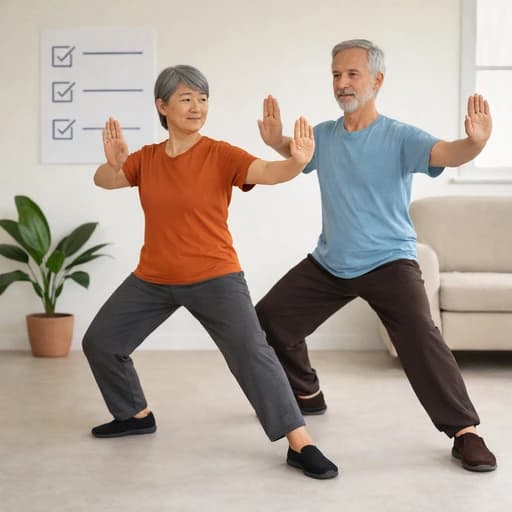
- use a higher stance
- shorten arm range
- stop before pain escalates sharply
- choose 10-minute sessions first
- keep support nearby if balance is limited
- use seated tai chi on flare days if needed
Standing vs seated tai chi for arthritis
Standing tai chi can help with balance and weight shift, but seated tai chi is often useful for people with severe knee pain, fatigue, foot pain, or fear of falling. It is not cheating. It is smart progression.
FAQ
References
- Kolasinski SL, Neogi T, Hochberg MC, et al. 2019 American College of Rheumatology/Arthritis Foundation Guideline for the Management of Osteoarthritis. https://pubmed.ncbi.nlm.nih.gov/31908149/
- Hu L, Wang Y, Liu X, et al. Tai chi exercise can ameliorate physical and mental health of patients with knee osteoarthritis. https://pubmed.ncbi.nlm.nih.gov/32954819/
- You Y, Liu J, Tang M, et al. Effects of tai chi exercise on improving walking function and posture control in elderly patients with knee osteoarthritis. https://pubmed.ncbi.nlm.nih.gov/33879749/
- Mudano AS, Tugwell P, Wells GA, et al. Tai chi for rheumatoid arthritis. https://pubmed.ncbi.nlm.nih.gov/31553478/
- CDC. About Physical Activity and Arthritis. https://www.cdc.gov/arthritis/prevention/index.html
Updated: 2026-04-15