
Reviewed by Arisa Tanaphon, Certified Tai Chi Instructor, Mindful Movement Specialist
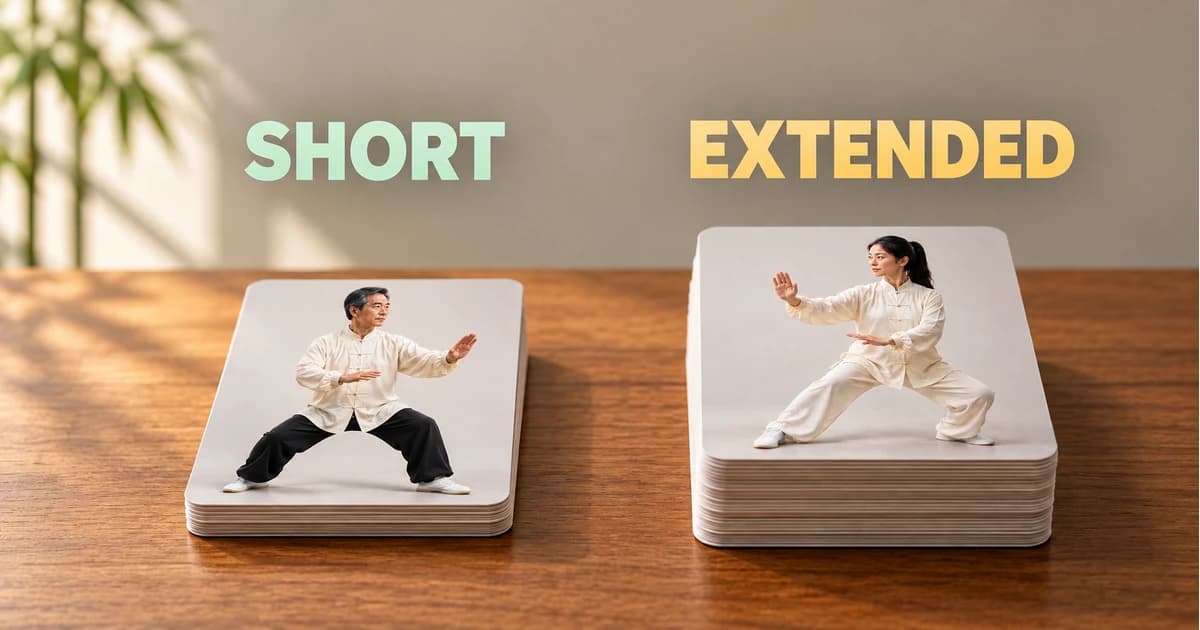
In Tai Chi for Seniors & Beginners, choosing an extended plan day adds movements within that day’s sequence. The shared movements keep their order. The short version is useful when you want fewer transitions to learn or a smaller time commitment.
The choice is separate from the plan’s level and from choosing standing or Chair Tai Chi. A longer day does not automatically mean a harder level, and a seated day can still contain demanding reaches and leg lifts. Preview the actual movement list in both versions.
Key takeaways
- Short and extended Tai Chi sessions differ in their movement lists. In Tai Chi for Seniors & Beginners, an extended plan day adds movements while preserving the shared sequence.
- Standing beginner day 1 has 10 short-version movements versus 21 extended-version movements: 5 versus 10 minutes 30 seconds of movement.
- Chair beginner day 1 has 10 versus 14 movements: 5 versus 7 minutes moving. Preparation, rest settings, and pauses add to elapsed time.
- The median recorded duration among completed app sessions was 10 minutes 41 seconds, September 1–October 14, 2026. Workouts and settings varied; this is not a target. Method.
Compare the actual first day in both beginner tracks
| Plan and version | Movements and movement time |
|---|---|
| Standing Beginner 30-Day Plan — short | 10 movements; 5 min of movement blocks; 7 min 30 sec estimated with preparation. |
| Standing Beginner 30-Day Plan — extended | 21 movements; 10 min 30 sec of movement blocks; 15 min 45 sec estimated with preparation. |
| Seated Beginner 30-Day Plan — short | 10 movements; 5 min of movement blocks; 7 min 30 sec estimated with preparation. |
| Seated Beginner 30-Day Plan — extended | 14 movements; 7 min of movement blocks; 10 min 30 sec estimated with preparation. |
Pro tip: These are day-one examples. Other days can have different counts. Extra pauses and your rest settings affect elapsed time.
What the standing extended day adds
On standing beginner day one, the extended version adds 11 movements. They include Arm Swings, Standing Arm Wave, Sunrise Flow, Centered Ball Hold. These are inserted into the session sequence rather than appended as an unrelated workout.
Some additions involve more than arm motion. Side Flow Step uses crossing footwork, and Floating Cloud Hands coordinates a turn and weight shift. More available time is only one reason to choose the extended day; readiness for those additional patterns matters too.
What the chair extended day adds
Seated beginner day one adds 4 movements in its extended version: Seated Knee Lift With Breath And Open Arms, Seated Twist Touch, Seated Cross Reach Right, Seated Cross Reach Left. These additions include arm-and-leg coordination, turning, and crossing reaches.
A chair supports your seated position, but does not remove the need to control a knee lift or a forward reach. Watch each unfamiliar addition and use a smaller range when learning. The seated leg exercise guide explains the difference between grounded-foot patterns and lifted-leg tasks.
A useful reference for session length
The middle completed workout length in our app was 10 minutes 41 seconds during this period. Half of the completed sessions with a recorded duration were shorter and half were longer. The workouts and settings varied.
Treat that as a picture of everyday practice, rather than a target. Compare the movement lists for the short and extended versions, then allow extra time to watch any unfamiliar transition.
From Tai Chi for Seniors & Beginners, September 1–October 14, 2026. About these numbers.
Choose by today’s task, then change one setting at a time
- Choose fewer movements when learning. Use the short day to familiarize yourself with the setups and transitions before adding more patterns.
- Preview additions before extending. Check the specific movements added to that day, rather than assuming the longer choice only repeats familiar material.
- Keep level changes separate. A higher level changes the plan content. Learn what changes when you alter duration before also changing the level.
- Keep pauses available. A longer rest can make a short sequence take more elapsed time without adding any exercises. That is different from the extended version.
For a realistic weekly schedule, see how often beginners can practice Tai Chi. You do not need to make every setting more demanding at once.
Use the first-week previews to inspect the choice
The plan pages show the first seven days in both versions. Open a day, switch between Short and Extended, and follow any movement name to its demonstration and instructions. The preview follows the same exercise order as the app.
In the app, plan settings let you choose your duration option and level. Standing and chair tracks keep their own saved progress when you change workout type. For a single fixed sequence instead, browse the workout library; its sessions are separate from the day-by-day plans.
Compare time without chasing a number
If you use a calorie estimate to plan activity, the Tai Chi calories guide explains why duration and body weight affect the calculation. A longer estimate does not tell you whether the movements fit your experience. Start with the session-selection advice in Tai Chi for beginners.
Updated: October 16, 2026